
Everyone needs plenty of storage in the home and shelving is one of the easiest ways of adding extra space – and for extra storage in your garage or shed you can fit racking.
Planning your shelving
It’s worth sketching out your plans beforehand for an alcove or wall to make the best use of the space. Adjust the spacing of the shelves according to what you are going to store – eg books/ CDs. This will also determine how strong the shelving material and fixings need to be.
Most walls are not exactly vertical so take measurements at the top, bottom and centre of an alcove to make sure the shelves will fit exactly.
Materials to use
Solid timber – solid wood is strong and available in a variety of planed widths to suit most shelving locations. Your local timber yard or DIY store should be able to cut the timber to exact length for you. Choose a minimum of 18mm thickness to stop sagging and support the shelf at 700mm centres. You can support heavy loads on timber shelves.
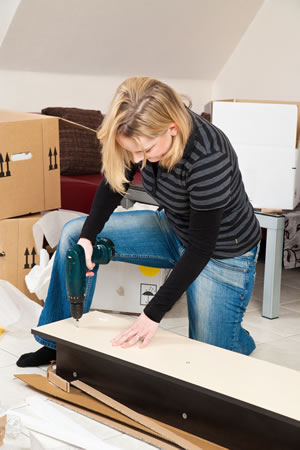
Chipboard – 16mm chipboard is much cheaper than timber and comes in a wide variety of facings – either natural wood shades or colours. The board can be cut easily but is more flexible than timber and should be supported at 450mm centres for heavy loads.
MDF – Is an ideal shelving material. It is stronger than chipboard and the edge can be routed or planed to give a decorative finish. MDF is also ideal for paint finishes. Support at 700mm centres for heavy loads and buy 18mm thickness to stop bowing.
Glass – Many DIY stores stock 6 and 9mm pre-cut glass shelving with their own fixings as a kit. These can be used for light to medium loads.
Box shelving
Make fashionable alcove box shelving from a simple frame of softwood with a 6mm MDF top. Fix timber brackets to the side walls and screw the sides of the frame to the brackets to conceal them. Screw on the ‘bottom’ of the box, again from 6mm MDF.
Using timber edging
You can make MDF, wood or chipboard shelves more rigid and reduce the chance of sagging by adding a solid wood lipping along the front of a shelf. Screw and glue the batten to the front edge or to the underside. A batten fixed to the wall and supporting the rear of the shelf can be used instead or as well.
Fixing shelves to the wall
The fixing you use to hold the shelving securely to the wall will depend on your type of wall and the loads on the shelf. Even narrow shelving with light loads should be held with screws which penetrate the wall by at least 40mm. Use wall plugs for block and brick walls and heavy-duty cavity fixings for stud walls. For more information on fixing shelving to the wall, read this: https://www.diyfixit.co.uk/building/how-to-put-up-a-fixed-shelf/
Types of fixing
Adjustable track – You can buy inexpensive adjustable fixing systems consisting of slotted metal uprights and metal brackets which screw to the underside of each shelf. Use a spirit level to make sure each upright is vertical and level with the next. Follow the maker’s instructions for the number of uprights needed for the width of shelving.
Fixed brackets – You can support alcove shelf ends on 25x50mm timber battens screwed to the wall. Bevel the front edges for a neater finish. For free-standing shelves, metal angle brackets may be used providing functional shelving. If you don’t want to see fixtures – use grooved shelf support brackets that are fixed to the wall along the length of the shelf. Clip the rear of the shelf into the groove.
