
This material is for information purposes only. Strict rules govern what electrical work can be done without notification and inspection.
The basics
Electrical installations are based on circuits. The electricity flows along a wire from the power source to the appliance. It then travels back to the power source again along another wire.
The flow to the appliance is the ‘Live’.
The return wire is the ‘Neutral’.
In order to be able to turn appliances on or off, we need to introduce a switch. This opens and closes a connection in the circuit. When closed, the connection is made and electricity can flow. When open, the connection is broken and electricity will not flow.
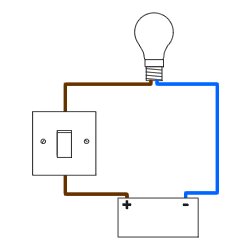
In a very simple circuit, the battery supplies the electrical current which flows along the live wire to the lightbulb. The current then continues back to the battery along the neutral wire. Whilst the switch would operate the lightbulb by being fitted in either wire, it must in fact always be in the live wire. If it were fitted in the neutral, the lightbulb could be switched off because the circuit had been broken but, because the break is after the lamp, the wires up to it and its connections would still be ‘live’. This would be exceedingly dangerous on a mains circuit since the lamp being off would give the impression that the power was off. In fact it would still be on and anyone touching the terminals at the lamp would receive an electric shock.
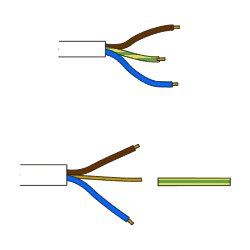
Wire colours
The wires in household electrics are colour-coded for ease of identification.
Brown (old cable colour = red) = live.
Blue (old cable colour = black) = neutral.
Green & yellow = earth.
Earth
The thing to remember is that the earth (ground we stand on) is a good conductor of electricity. Given the chance of a good conductor and a shorter route, electricity will take it. This means that if you place yourself between the two, it will travel through you to get there.
The same happens when a metal object touches the electricity. It is given the choice of a shorter route and will take it.
By understanding this principal, you will see the reason for the inclusion of an earth wire in electrical circuits. It provides a direct route to earth in case a fault develops. For example, should a live wire accidentally come into contact with a metal appliance, it will immediately ‘earth out’. This change of flow in the system causes the fuses or circuit breakers to ‘blow’.

There is an earth conductor in the cables of circuits as well as in the wires used to connect fitting and appliances. The exception to this is for double insulated appliances which do not need and must not have an earth.
Check the labelling on an item for the double insulated symbol.
Fuses
Fuses are a weak link in a circuit. The wire used in them is thinner than that used in the rest of the circuit. When a fault occurs in a circuit, either through overloading or ‘earthing out’, there will be a significant increase in power through the cables. This causes the thinner fuse wire to heat up and melt. When it does so, it breaks the circuit, switching off the power.
The point at which a fuse ‘blows’ is determined by the thickness of the wire. Different sizes blow at different levels of power. They are graded according to the maximum current (measured in amps) which they will support without melting. Exceeding this maximum will cause the wire to break. Nowadays, modern installations make use of ‘circuit breakers’ instead of the old style fuse wires. These devices will detect an increase in the current and automatically switch off the power. The beauty of these is that they can simply be reset at the touch of a button – literally.
However, always find and rectify the cause of the fault before resetting a circuit breaker or replacing a fuse. Remember, the fuse has blown for a reason – to tell you something is wrong – don’t ignore it!
The two main reasons for a fuse or circuit breaker blowing are: overloading the circuit and earthing fault.
