
Appliances which are located in a permanent position may be connected to the power supply with a fused connection unit. Some in fact may only be connected in this way.
For bathrooms, these must be mounted out of reach – outside the room, or for an appliance like a radiant heater (which itself must be mounted high up), high enough that it cannot be touched when using the bath or basin.
These units have their own fuse which provides additional protection at this point. They can be connected as part of a ring main, as a spur from a ring main or on their own radial circuit. Indeed for some appliances the latter is the only allowable method, and you should employ a professional electrician to do this work.
The procedure for installing a fused connection unit in a ring main or as a spur from a ring main is similar to that for a socket outlet. The difference being that the flex or cable for the appliance also has to be connected.
Connecting the fused connection unit
1. Switch off the power at the consumer unit for the circuit concerned. If you have removable fuses at your consumer unit, switch off the power at the consumer unit and remove the fuse for this circuit.
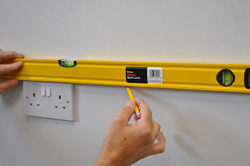
2. Decide on the location of your fused connection unit making sure that you comply with current regulations. If it is being mounted adjacent to a socket outlet make sure they align.
3. Mount the back box or pattress for the fused connection unit. The way to do this will depend on the type of fitting and the wall. You may use a Surface Mounted Box, a Flush Mounted Metal Box, or a Flush Mounted Plasterboard Box.
For this example we are mounting a flush box in plasterboard.

4. Mark the outline of the plastic box on the wall with a pencil
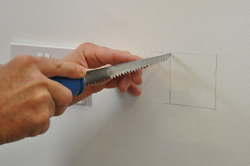
5. Make certain there are no services behind the box which may get damaged. Using a pad saw, carefully pierce the plasterboard in one corner of the outline marked.
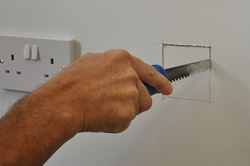
6. Holding the padsaw square to the wall, saw along each of the edges gently. Once you have cut right round the outline, remove the waste.
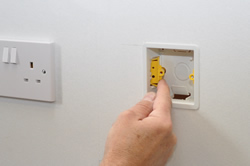
7. Having removed the blanking piece for the cable entry point, insert the plastic plasterboard socket box into the opening and secure with the lugs at the sides.
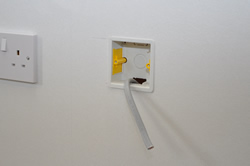
8. Feed the cable being used to supply this fused connection unit, or FCU as they are referred to, via the entry point into the box
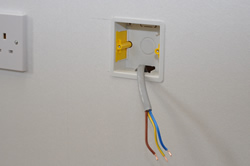
9. Strip and prepare the cable. See our Cable Stripping Guide for detailed information on this.
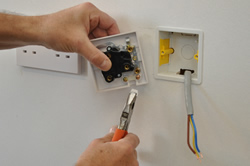
10. Depending on the type of FCU you are using you may have to break out the appliance flex outlet blanking piece. To do this, grip it squarely with a pair of pliers and lever it out. This should snap out cleanly leaving a smooth edge to the outlet point.
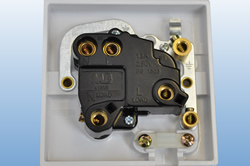
11. Looking at the back of the face plate of the fused connection unit you will find there are more connection terminals than on a socket outlet.
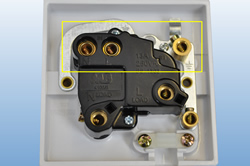
12. There will be two labelled ‘IN’. These will also be individually labelled ‘N’ and ‘L’. These are the connections for the incoming mains supply Neural and Live.
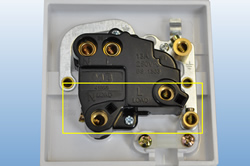
13. There will be two marked ‘N LOAD’ and ‘L LOAD’. These are the connections for the Neutral and Live for the appliance being connected.
14. There will also be two earth terminals appropriately marked with the earth symbol.
15. Depending on whether this FCU is being connected as a spur or as part of the ring main you will have either one or two cables. For this example we are connecting it as a spur from an adjacent socket outlet and therefore have just one cable.
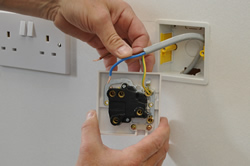
16. Insert the sleeved earth of supply cable into the terminal marked with the Earth symbol and secure by tightening the screw
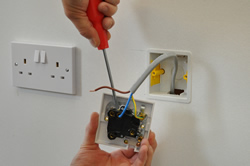
17. Insert the blue (old cable colour = black), neutral conductor of the mains supply cable, into the terminal marked ‘N’ ‘IN’ and secure by tightening the screw.
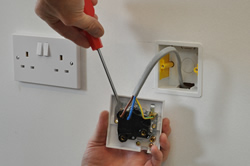
18. Insert the brown (old cable colour = red), live conductor of the mains supply cable, into the terminal marked ‘L’ ‘IN’ and secure by tightening the screw.
Connecting the appliance
19. Make sure that the flex or cable has already been correctly connected to the appliance itself.
20. Some types of FCU have the appliance outlet though the faceplate. If you have this type, feed the flex through the faceplate first.
21. Strip and prepare the flex in the normal way, separating the conductors and trimming back the insulation of each by about ½”. Twist the individual filaments of each conductor.
22. Slacken the screws on the terminals marked ‘N LOAD’ and ‘L LOAD’ as well as the corresponding earth terminal.
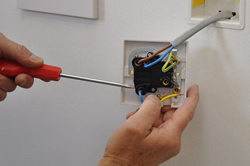
23. Insert the blue conductor into the terminal marked ‘N LOAD’. Fasten the screw and make sure the wire is firmly secured
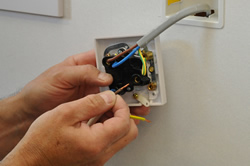
24. Repeat the process inserting the brown conductor into the terminal marked ‘L LOAD’.
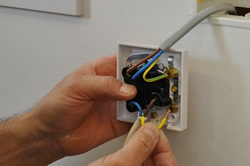
25. Repeat the process inserting the green/yellow conductor into the terminal marked with the earth symbol.
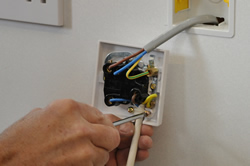
26. Fasten the flex with the cord grip provided which guards against the connections being pulled loose.
27. Finally, double check that all your connections are firmly secured and that the insulated part butts up to the terminals leaving no exposed conductor.
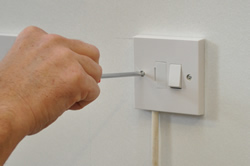
28. Ease the face plate back to the box, carefully folding the supply cables into it as you go. Make sure that the flex doesn’t get snagged as you do this. Secure with the retaining screws tightening them alternately to draw the unit back evenly to the surface.
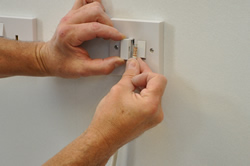
29. Check that the FCU is fitted with the correct rated fuse for you appliance. Access to the fuse is commonly via a pull-out or screw-fitted panel mounted in the face plate.
30. Once you are sure that all work has been completed correctly, switch the power back on at the consumer unit. In the case of removable fuses, replace the fuse for the circuit, and switch the power back on.
