
This material is ” for information purposes ” only. Strict rules govern what electrical work can be done without notification and inspection.
Lamp holder types
There are two types of lamp holder, plastic and metal. They may be found as part of a table lamp, or as a part of a pendant light fitting. The method of connection is similar for both pendant type and table lamp, but the metal and plastic types require different considerations.
The first difference to note is that plastic fittings have no earth connection and should therefore only be connected via a two core flex. Metal fittings must always be connected via a flex with an earth wire.
Metal versus plastic lamp holders
The second consideration is that metal fittings are not suitable in some locations – the most notable of which is bathrooms. Plastic ones may be used in bathrooms, but choose the type with a longer plastic shroud which shields the components better. In practice, metal lampholders are generally only used for certain types of table lamps.
Connecting the flex to the lampholder
1. Switch off the power at the consumer unit for the circuit concerned. If you have removable fuses at your consumer unit, switch off the power at the consumer unit and remove the fuse for this circuit. Or, in the case of a table lamp, switch off and remove the plug from the power supply.
2. Unscrew the fitting to expose the separate components. The construction of metal and plastic ones is a little different as you will notice from the pictures.
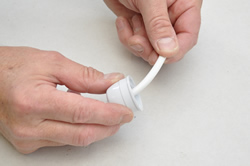
3. Feed the top cover (and retaining pieces in the case of the metal fitting) over the flex and push them along out of the way.
4. Note the length required for the conductors to reach their terminals, then strip and prepare the flex. More detailed information can be found in our Stripping and Preparing Flex article.
5. Using a pair of side cutters, cut back the outer sheath of the flex accordingly and trim off the excess.
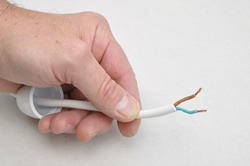
6. Separate the conductors and strip the insulation of each back by about 1/2″. Twist together the separate filaments of each.
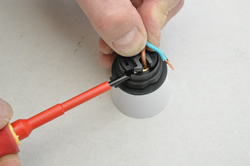
7. Connect the brown (live) to one terminal and secure with the retaining screw.
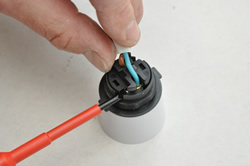
8. Connect the blue (neutral) to the other terminal and secure with the retaining screw.
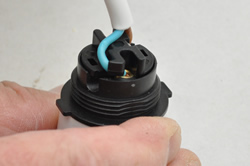
9. Make sure that both are fed round the supports which prevent strain on the connections.
Earth for metal lampholders
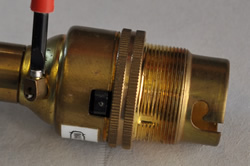
10. In the case of metal fittings which, as noted earlier, must be earthed, you will find a small externally mounted earth terminal. This example is a metal lamp holder on a table lamp.
11. The green and yellow earth conductor is fed to this from inside the fitting and secured with the retaining screw.
Reassemble the lamp holder
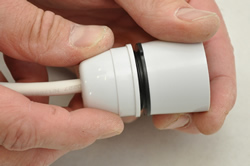
12. Double check your connections then slide the previously threaded components back down the flex and reassemble the fitting, taking care not to damage or pull the wires in the process.
