
Power for the spur may be supplied from another socket outlet on the ring provided it does not already have a spur from it and it is not a spur itself. Check with the I.E.E regulations to ensure compliance.
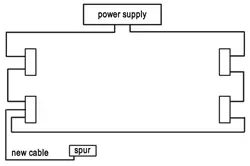
1. Plan for the new socket outlet.
2. Switch off the power at the consumer unit for the circuit concerned. If you have removable fuses at your consumer unit, switch off the power at the consumer unit and remove the fuse for this circuit.
3. Inspect the wiring at the socket. You must make quite sure that this circuit is indeed a ring main. If you are not absolutely certain, consult a professional electrician.
- If it has one cable, it is itself likely to be a spur and cannot, therefore, be used.
- If it has two cables it may be a suitable socket on the ring, assuming that somebody has not incorrectly connected a spur from another spur.
- If it has three cables, it indicates that it is already feeding a spur and may not be used.
Adding the new cable
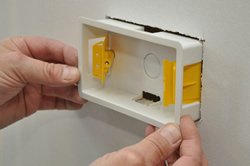
4. Having identified a suitable socket to which you may add a spur, fit the box for the new socket at the required position. The method for doing this will depend on whether it is a Surface Mounted Box, Flush Metal Box, or Plasterboard Box.
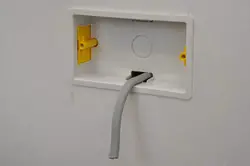
5. Run cable from the socket which will be feeding the spur to the new socket position.
Connect up the new socket
6. Having fed the cable into the socket box at the new position, strip the cable ends ready for connection. See our Cable Stripping Guide for detailed information on this.
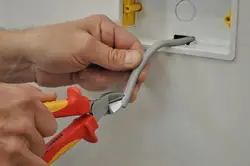
7. Cut through the outer sheath of the cable carefully using a pair of side cutters. Be sure not to cut into the insulation of the conductors.
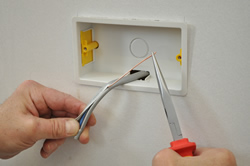
8. Peel back the sheath to reveal the conductors and grip the end of the bare earth conductor with a pair of pliers. Draw the wire back through the sheath like a cheese wire.
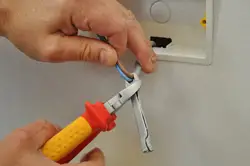
9. Cut off the excess sheath with a pair of side cutters.
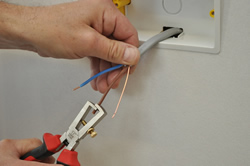
10. Separate the conductors and trim the insulation of each back by about 1/2″ with wire strippers.
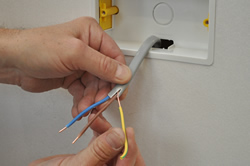
11. Insulate the earth conductor using the separately sold green and yellow sleeving. This should be cut to length and fed over the conductor so that about 1/2″ is left exposed at the end to match the other conductors.
Connecting the cable to the new socket outlet
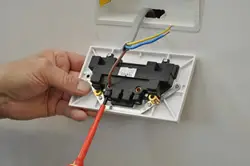
12. Slacken the screw of the appropriate connection terminal. Insert the brown (old cable colour = red), live conductor into the hole in the terminal marked ‘L’.
13. Ensure that the conductor is fully housed and that there is no exposed wire showing. Fasten the screw and make sure the wire is firmly secured.
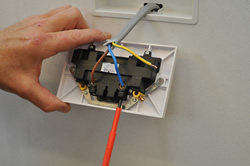
14. Repeat the process for the blue (old cable colour = black), neutral conductor, fixing it into the terminal marked ‘N’.
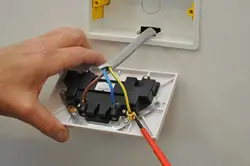
15. Repeat the process for the green/yellow sleeved earth conductor fixing it into the terminal marked with the earth symbol.
Metal Boxes Only
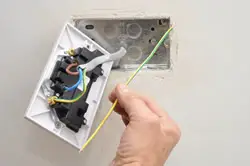
16. An earth tail must be fitted between a socket outlet and metal back box where both socket fixing lugs are adjustable. If this is what you have, cut a suitable length of the earth conductor from some cable of the same size as that used for the circuit. Sleeve this with green and yellow sleeving allowing ½” conductor to be exposed at either end.
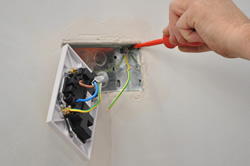
17. Connect one end of this earth tail to the earth terminal provided at the back of the metal mounting box.
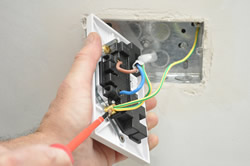
18. Connect the other end of this earth tail with the earth conductor secured to the terminal marked with the earth symbol on the socket outlet.
Fixing the socket-outlet
19. Double check that all your connections are to the correct terminals, and securely fastened.
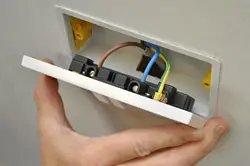
20. Carefully push the face plate back, gently folding the cables as you go, so that they sit neatly into the box.
21. Fasten the face plate with its retaining screws. Tighten the screws alternately to draw the plate back evenly.
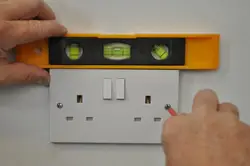
22. As you tighten these, ensure that the face is level. One or both of the screw mountings will have allowance for a small amount of vertical adjustment which assists with this.
Preparing the Existing Socket
23. Slacken the fixing screws and remove the face plate of the socket to which you are going to connect.
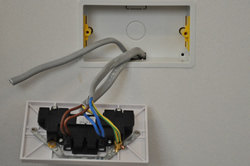
24. If there is sufficient space alongside the other cables, feed the new cable feeding the spur through the cable entry point of the box. Allow enough cable for making the connections.
25. If not, remove one of the other blanking plates in the box to provide entry for the new cable. If it’s a metal box, fit a rubber grommet to the new entry hole and feed the cable in.
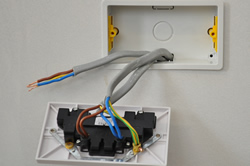
26. Strip and prepare the end of the new cable ready for connection. Protect the exposed earth conductor with green/yellow sleeving.
Connecting the spur cable at the original outlet
27. Slacken the screws on the connection terminals and insert the conductors of the new spur cable into the corresponding terminals alongside the existing ring main conductors.
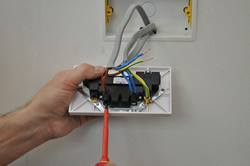
28. There will now be three brown (old cable colour = red) conductors in the terminal marked live (‘L’). Tighten the terminal screw.
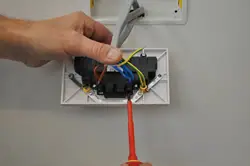
29. There will be the three blue (old cable colour = black) conductors connected to the terminal marked neutral (‘N’). Tighten the terminal screw.
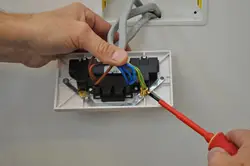
30. Repeat the process with the three green and yellow sleeved conductors connecting them to the terminal marked earth (earth symbol). If you have a metal mounting box and there was an earth tail connecting between the socket and the earth terminal on the back of the metal mounting box, this should also be connected.
31. Ensure that the conductors are firmly held and that the insulated part of each butts right up to the terminal.
Re fixing the socket outlet
32. Double check your connections and ease the face plate back to the box folding the cables carefully as you do so.
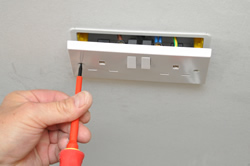
33. Re fix the retaining screws, tightening them alternately to ensure that the plate is drawn back evenly.
34. As you tighten these, ensure that the face is level. One or both of the screw mountings will have allowance for a small amount of vertical adjustment which assists with this.
35. Once you are sure that all work has been completed correctly, switch the power back on at the consumer unit. In the case of removable fuses, replace the fuse for the circuit, and switch the power back on.
36. Check your new socket to ensure that it is working properly.
